Why didn’t they ask Evans
Why Didn't They Ask EvansThe question “Why didn't they ask Evans?” is the novel’s central recurring expression: first a dying man’s baffling last words, then a detail Bobby Jones regrets withholding, and finally a clue to how John Savage’s will was supposedly falsified. Its meaning emerges by degrees. The phrase points not to an answer Bobby can immediately understand, but to a witness whose presence could have exposed an impostor—and turns an apparently meaningless utterance into a thread linking Alan Carstairs’s death to the investigation of Savage’s affairs.
The Last Words at Marchbolt
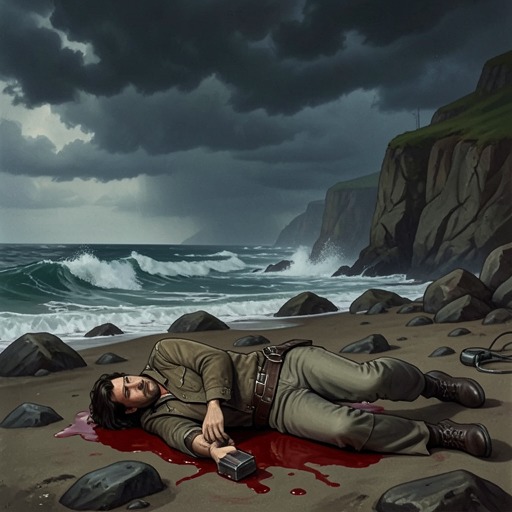
When Bobby Jones reaches the fallen stranger, the man’s face appears alert and conscious. The man speaks clearly before a shudder passes over him and he dies. His final question is “Why didn't they ask Evans?” In the moment, Bobby has no way to connect it to the stranger’s identity or circumstances. The abruptness of the words, followed immediately by the death, gives them the force of a clue while withholding the information that would make them intelligible.
The question initially remains outside the official account Bobby gives of the encounter. Later, while playing golf with Frankie Derwent, he remembers that the Caymans had asked whether the man said anything before he died. He had told them that he had said nothing, not because he had forgotten the words deliberately, but because he had not regarded the odd question as the sort of meaningful final statement they seemed to be asking about. Frankie treats the omission as unimportant, contrasting the phrase with the sort of explicit message that might identify a loved one or reveal the location of a will. Bobby agrees aloud, but the mismatch between what he said and what happened leaves him faintly troubled.
Bobby does subsequently write to the Caymans and report the question, adding that he thinks it probably unimportant. The reply politely agrees with that assessment and thanks him for taking the trouble. When an offer then arrives inviting Bobby to work in South America, Frankie connects the apparent attempt to send him away with a later attempt to poison him. She reasons that the people behind the death may fear that the phrase could lead Bobby to recall or discover something else. Her theory is that they cannot know exactly what the question means to him, so they act to keep him from following it.
From Refrain to Investigative Clue
The expression’s repeated return changes its status. At first Bobby remembers it as an unexplained remark, and Frankie later asks what the dead man said because the circumstances around Alan Carstairs and the photograph remain unresolved. Their discussion connects the question to the possibility that the body was deliberately misidentified: a photograph of Mrs Cayman had been put in the dead man’s pocket, while another photograph had been removed. Bobby and Frankie suspect that this was part of a broader scheme involving The Caymans and an effort to make the death appear accidental. At this stage, however, the question itself does not explain who Evans is or why anyone would be threatened by the words.
Frankie’s reasoning about the conspirators’ response is a crucial intermediate step. The phrase may have been highly significant to them even though it sounds trivial to Bobby. She suggests that they might fear the dying man had said something else that Bobby would remember later, and that making Bobby unavailable was safer than arranging another apparent accident so soon after the first. In this way, the expression functions as a clue about the perpetrators’ knowledge and anxiety before it functions as a clue to the will scheme. Its apparent simplicity is part of the problem: the characters know it matters, but not yet what it means.
The investigation briefly makes the question seem almost detached from the answer. While travelling to London, Bobby and Frankie consider whether Alan Carstairs had come to the area with the Rivingtons, whether he had been following a gang, or whether he had been looking for a girl. Frankie observes that the Evans part of the mystery must have something to do with Wales, but they still lack information about Evans herself. The expression thus acts as an organizing refrain: new people and possible explanations accumulate around it, while the person named in it remains absent.
The Mystery as a Play
Frankie gives this experience a structural image when she says that she and Bobby seem to have entered someone else’s story in the middle. She revises her sense of where they have entered: perhaps it is closer to the third act than the second, and the final curtain may be near. In that analogy, the five-word question is their cue onto a stage whose earlier action they have not seen. It is at once the start of their involvement and a reminder that they are working from incomplete knowledge.
The play image also captures the expression’s peculiar balance between prominence and obscurity. It recurs, brings new characters and suspicions into the investigation, and appears to promise a hidden explanation; yet Bobby wonders whether Evans may not matter at all. Later, when he and Frankie believe they are about to die, Bobby is still frustrated that they have not discovered who Evans is. Frankie proposes asking, treating the answer as a last-minute satisfaction of curiosity. Their fear and their continued attention to the question make its unresolved status part of the scene’s tension: even at the apparent end, the mystery’s first clue has not yet yielded its name.
The Answer in the Will
The decisive turn comes when Frankie questions a detail in the account of John Savage’s will. She wonders why Mrs Templeton sent for the gardener to witness it when the house parlourmaid was present. Bobby recognizes the connection: the parlourmaid’s name was Gladys Evans. The wording of the dying man’s question now becomes exact rather than metaphorical. Carstairs, like Bobby and Frankie, had apparently noticed that the household had not asked Evans to witness the will.
Frankie reasons that the omission may be explained by what Evans would have been able to see. A parlourmaid might serve a visitor at dinner, call for him, and bring him coffee; in Frankie’s reconstruction, Evans would therefore have recognized that the person signing the will was not John Savage. She concludes that Roger Bassington-ffrench impersonated Savage when the will was made. The other witnesses, as Frankie describes them, would have been less likely to identify the deception: one was a stranger who did not know Savage, while the other was an elderly man whom she believes may not have known him either. The conspicuous choice not to ask Evans is thus recast as evidence of deliberate exclusion.
Frankie further supposes that the real Savage was drugged and kept out of sight while the impersonation took place, then returned to his bed and given chloral; Evans subsequently found him dead. These details are presented as a reconstruction, not as a proven account. Bobby immediately asks whether they can establish it, and the two consider possible corroboration: whether Rose Chudleigh could distinguish the real Savage from the signer, and whether an expert could identify a forged signature. They acknowledge that proof may be difficult, partly because nobody had previously questioned the will’s authenticity. Their next practical step is to find Gladys Evans, who had served the Templetons for six months and might know more.
Significance and Resolution
The expression’s eventual explanation does not make it a self-sufficient solution. It directs attention to an overlooked witness and to the suspicious circumstances of the will, but the characters still have to infer why she was excluded, identify the alleged impersonation, and ask what evidence could confirm it. The trail moves from a dying man’s words, through Bobby’s uneasy omission and the danger that follows his disclosure, to Frankie’s careful scrutiny of a seemingly minor household arrangement.
That progression gives the phrase its double role in the mystery. It is both a literal question about why no one asked Gladys Evans and a formal device that keeps the investigation circling a missing piece of the story. The answer is not that Evans has already explained events: she has not yet been found. Rather, the question reveals the significance of her absence. What once sounded like an arbitrary last utterance becomes a pointer to the person whose testimony might expose the false identity behind Savage’s will, while the gap between suspicion and proof remains open.